| |

Home
The
Forth
Junction
Project
Rails and
Trails
Historic
Trails
Rail History of
Central
Alberta
Rail Heritage
Preservation
High Speed
Rail
Corridor
for
Alberta
The Trans
Canada
Trail in
Central Alberta
Innovative
Transport
Sustainable
Community
Heritage
Regional
Rail History
Red Deer
and Area


|
Rails
and Trails
revised July 2012
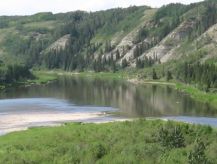
The first transportation corridors
in Central Alberta were the rivers and their many
tributaries. A series of trails used by native peoples, fur traders and
explorers opened up the region for the earliest European settlers and missionaries.
The original locations of Red Deer, Innisfail and Tail Creek were
determined by the confluence of a river and trails.
Some of the more famous trails
in the region include the
Calgary and Edmonton Trail (an
ancient trail that had been formerly
known by explorers and traders as the Wolf's Track Trail, Bow Trail and Old North Trail), Morley
Trail, Rocky Mountain House Trail, Burnt Lake Trail, Cowboy Trail,
Explorer's Trail, Coal Trail, Boomtown Trail and First Nations' Overland
Trail.
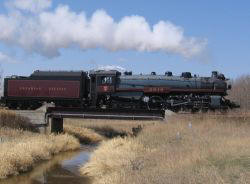 However the most profound mode of transportation that determined the
location of new communities and the sustainability of older ones was the
coming of
the railroad.
The railroad encouraged an influx of settlers from many corners of the
world and made possible the distribution of agricultural products and
the many natural resources of the area. It also displaced trails and
waterways as the principle means of moving people and goods. However the most profound mode of transportation that determined the
location of new communities and the sustainability of older ones was the
coming of
the railroad.
The railroad encouraged an influx of settlers from many corners of the
world and made possible the distribution of agricultural products and
the many natural resources of the area. It also displaced trails and
waterways as the principle means of moving people and goods.
Communities were created, disappeared or relocated as a result of where
the railroads chose to build. The town sites of Red Deer and Innisfail
were relocated and the new towns of Lacombe, Blackfalds, Bowden,
Delburne, Sylvan Lake, Benalto, Eckville, Mirror, Big Valley and
Stettler were determined by where one of the railroads built
its line, its water tanks and its grain handling facilities.

Major distribution centres, including Red Deer, were determined in large
part by where the railroads established their divisional points. At one point, four railroads
were built or were planned to be built in nine directions out of Red
Deer. In many cases, when the railroad left, communities stopped growing
or even declined. For fifty years, the railways enjoyed being the major
means of transportation for people and products as well as the centre of
communication and social interaction.
But as historic trails became roads and the affordable automobile gave
people flexibility and freedom of mobility, the railways' role of being
the only dependable way for people on the prairies to get from place to
place started to decline. With the advent of air travel combined with
the popularity of motor vehicles, many passenger trains were
discontinued, especially in the mid to late 1950s. As rail lines became
less profitable, many were abandoned over the next 40 years and the
railways increasing concentrated on freight and bulk goods.
 But history has a way of going full circle. But history has a way of going full circle.
On the one hand, more and more people are looking for organized trails
as a means of healthy and inexpensive recreation in a natural and
diverse environment. People are looking for active transportation
corridors that are safe but provide the opportunity to appreciate
culture, history and various uses of the landscape.
The logical extension of that quest is the use of abandoned railway
lines where available. These lines are natural linear corridors that
connect communities, recreational areas and provide an appreciation of
our agricultural roots.
 The
construction of rural bicycle and walking trails represent an alternate
and economical form of getting around. In addition, they are necessary
for the safety of our children and youth by providing an alternative to
walking or bicycling on busy and dangerous highways. The
construction of rural bicycle and walking trails represent an alternate
and economical form of getting around. In addition, they are necessary
for the safety of our children and youth by providing an alternative to
walking or bicycling on busy and dangerous highways.
While some trails can be dedicated to walkers, runners and bicyclists,
other trails could be dedicated to snowmobiles, off-road vehicles and/or
horses, depending on the needs and efforts of communities and interest
groups.
The Trans Canada Trail in central Alberta, when
completed, will, in some sections, generally
follow the historic Calgary and Edmonton Trail corridor, some portions
of which may be built parallel to Highway 2A.
 Already excellent trail systems,
including sections of the TCT, exist in Red Deer, Innisfail, Lacombe
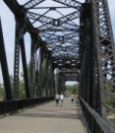
and Ponoka. A former CPR railway bridge in downtown Red Deer has been
preserved and is now part of the extensive Waskasoo Park trail system.
Trans Canada Trail rural linkages are being planned and/or developed to
join these communities together. Already excellent trail systems,
including sections of the TCT, exist in Red Deer, Innisfail, Lacombe
and Ponoka. A former CPR railway bridge in downtown Red Deer has been
preserved and is now part of the extensive Waskasoo Park trail system.
Trans Canada Trail rural linkages are being planned and/or developed to
join these communities together.
Two major pedestrian bridges were constructed in 2010 at the Blindman
and Battle Rivers. Lacombe County has made considerable progress --
first, linking the Blindman River bridge to Blackfalds, and then,
linking Blackfalds with the city of Lacombe. Plans are under way to link
Red Deer with Bowden through Springbrook, Penhold and Innisfail as well
as Lacombe with Ponoka. Some areas, including from Red Deer to the
Blindman River bridge, are using the historic former Calgary and
Edmonton Trail.

Some
trail corridors may be established using former railway rights of way,
including Red Deer to Sylvan Lake on the former Alberta Central Railway
subdivision of Canadian Pacific Railway which was abandoned in 1983 and
purchased by Red Deer County in 2009, Rocky Mountain House to Nordegg on
the former Canadian Northern Western Railway operated until 1955 by the
Canadian National Railway, Torrington to Irricana on the former Acme
subdivision of Canadian Pacific Railway, and Big Valley to Morrin on the
former Canadian Northern line that became the southern portion of the
Stettler subdivision of Canadian National.
Other possible future trail corridors may include: along the Red Deer
River east and southwest of Red Deer, Red Deer to Delburne, along the
Medicine River from Benalto to Glennifer Lake, the Boomtown Trail along Highway 21,
and other areas, Further
down the road, more trails could develop with linkages to Pine Lake,
Buffalo Lake and Gull Lake.
 On
the other hand, as gas gets more costly, highways get more congested
and there's a greater awareness of our carbon footprint, passenger
travel by rail is gaining more attention both within urban areas and
between them. On
the other hand, as gas gets more costly, highways get more congested
and there's a greater awareness of our carbon footprint, passenger
travel by rail is gaining more attention both within urban areas and
between them.
As the population of the region grows with migration of people from
areas where a high level of public transit is normal, as the resident
population ages, and as the cost of fuel increases, there will be an
increasing trend to use alternative transportation if it is available,
efficient and environmentally-friendly. Dedicated right of ways need to
be established that could some day evolve into a mass transit system
like light commuter rail or street cars.
 For longer distances,
a proposed
high speed train between Calgary and Edmonton could whisk people between
the two major centres in as little as 85 minutes. A Red Deer terminal
site has yet to be determined but one option is an intermodal terminal
at the Red Deer Regional Airport. An integration between those two modes of travel
could be
very beneficial to the growth and economy of the region providing that
an efficient feeder system is established from downtown Red Deer and
surrounding communities to the terminal. Rights of way need to be
determined in the very near future for various forms of rapid public
transportation. For longer distances,
a proposed
high speed train between Calgary and Edmonton could whisk people between
the two major centres in as little as 85 minutes. A Red Deer terminal
site has yet to be determined but one option is an intermodal terminal
at the Red Deer Regional Airport. An integration between those two modes of travel
could be
very beneficial to the growth and economy of the region providing that
an efficient feeder system is established from downtown Red Deer and
surrounding communities to the terminal. Rights of way need to be
determined in the very near future for various forms of rapid public
transportation.
Historic Trails in Central Alberta
The Calgary and Edmonton Trail
The Railway History of Red
Deer and Central Alberta
The Calgary and Edmonton Railway
(Canadian Pacific)
The Calgary and Edmonton Railway
near Red Deer
(Canadian Pacific)
The Alberta Central Railway
(abandoned Canadian Pacific)
The Canadian Northern
Western Railroad (Canadian National Brazeau sub)
The Canadian Northern Railroad
(Canadian National)
Railway Heritage Preservation
in Central Alberta
The Alberta Central Heritage Model
Rail Project
'Moving People by Rail' Themed
Community Proposal
Historic Rail Background
for 'Moving People by Rail'
The Vision of Inter-Urban Rapid
Passenger Transportation Corridors in Alberta
Progress on the
Completion of the Trans Canada Trail in Central Alberta
 The Forth
Junction Project The Forth
Junction Project
Central
Alberta Regional Trails
|
|
|