| |

Home
The
Forth
Junction
Project
Rails and
Trails
Rail History of
Central
Alberta
Innovative
Transport
Sustainable
Community
Heritage
Rail
Heritage
Preservation
Regional
Rail History
Alberta Central
Railway
(CPR)
Calgary
and
Edmonton
Railway
(CPR)
Canadian
Northern
Western
Railway (CNR)
Canadian
Northern
Railway
(CNR)
Red Deer
and Area



|
The Railway History
of Red Deer and Central Alberta
Early surveys for the Canadian Pacific Railway looking for a way through
the Rocky Mountains, had initially recommended a northern route through
Yellowhead Pass (which was later adopted by both the Canadian Northern
and Grand Trunk Pacific). An alternate route recommended the Howse Pass
west of Rocky Mountain House to the Pacific Ocean which, if chosen,
would have had the transcontinental railroad go through or very near to
the present site of Red Deer. But, more due to competition threats from
American railroads than anything else, the Canadian Pacific chose a
southern route even thought the land was less hospitable to agriculture
and the Kicking Horse Pass was more difficult.

When the transcontinental Canadian Pacific Railway arrived in Calgary in
1883, the
Calgary and Edmonton Trail gained major significance as the
north-south stagecoach route between Calgary and Edmonton with
communities and stopping houses developing along the trail at a number
of locations including Poplar Grove (Innisfail),
the Crossing at the Red Deer River and the Barnett ranch (Lacombe).
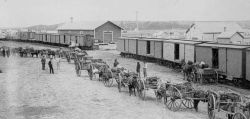 It wasn't long before the value of a railway joining Alberta's two major
population centres (Calgary and Edmonton) became obvious. It wasn't long before the value of a railway joining Alberta's two major
population centres (Calgary and Edmonton) became obvious.
From 1885 to 1890, a series of charters were granted to a number of
companies to construct a rail line from Calgary to Edmonton but most
never succeeded in getting started as a result of lack of financing.
The Alberta and Athabasca Railway Company was to start in the summer of 1887
with a line from Calgary through Drumheller and north
along the west side of Buffalo Lake to Edmonton (later somewhat adopted by the
Grand Trunk Pacific Railway). Had this been built at that time, it may
have changed the principle corridor between the two major cities and the
location of several municipalities that thrive in the corridor today.
But a more direct route between the two major communities was desired.
A revised charter was to take the railway near the proposed
Alberta Lumber Company facilities (built in 1887) near Innisfail, owned
by the same principals as the railway. It was to cross the Red Deer
River northwest of present-day Innisfail where a townsite was laid out
near the river and was to run west of the river northward. Grading
commenced in 1887 but stopped after a month due to continued financial
problems. Again, it would have had a significant impact on the location
of communities.
Another revision put the proposed route near the mouth of the Blindman River (a few miles
northeast of the current city). A new
charter changed the name to the Alberta and Great
Northwestern Railway.
That charter was sold to a new company, the Calgary
and Edmonton Railway Company, in early 1890. Once completed, the
line was to be leased to the Canadian Pacific Railway for 6 years with
an option to renew the lease or buy out the line.
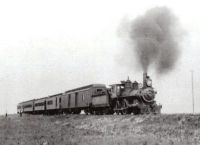 Construction started north of Calgary in 1890 but a decision was yet to
be made as to where it would cross the Red Deer River. Three routes had
been surveyed -- the one near Innisfail, one at Red Deer Crossing and
one at the mouth
of the Blindman River (17 miles downstream from the Crossing), the
preferred route as it necessitated only one river bridge instead of two. Construction started north of Calgary in 1890 but a decision was yet to
be made as to where it would cross the Red Deer River. Three routes had
been surveyed -- the one near Innisfail, one at Red Deer Crossing and
one at the mouth
of the Blindman River (17 miles downstream from the Crossing), the
preferred route as it necessitated only one river bridge instead of two.
The overall route was to follow the general C & E Trail corridor but the railway
decided on its own route to reduce the grade of the railway or to
accommodate preferred locations for communities. North of Poplar Grove
(renamed Innisfail) to south Red Deer, the railway was built a couple of
miles east of the C & E Trail.
The settlement at the Crossing, where the historic Fort Normandeau is
located, generally expected that the railway would cross the river at
that settlement. In fact, a townsite had been laid out in anticipation
of the railway going through there.
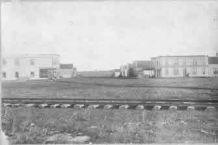 In
July of that year, James Ross, on behalf of the railway, met with Rev.
Leonard Gaetz, one of the largest landowners near the river who had
a great deal of political influence and was one of the principle
promoters of the region in Calgary and eastern Canada. When Rev. Gaetz
offered to give the railway half interest in 600 acres of land to
build the townsite and railway there, Mr. Ross gladly accepted, much to
the chagrin of the settlers at the Crossing. The rest, they say, is
history -- see
Calgary and Edmonton Railway
and
Calgary and Edmonton Railway near Red Deer. In
July of that year, James Ross, on behalf of the railway, met with Rev.
Leonard Gaetz, one of the largest landowners near the river who had
a great deal of political influence and was one of the principle
promoters of the region in Calgary and eastern Canada. When Rev. Gaetz
offered to give the railway half interest in 600 acres of land to
build the townsite and railway there, Mr. Ross gladly accepted, much to
the chagrin of the settlers at the Crossing. The rest, they say, is
history -- see
Calgary and Edmonton Railway
and
Calgary and Edmonton Railway near Red Deer.
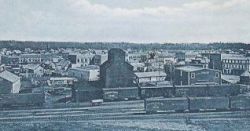 Once
the townsite was determined, the settlers at the Crossing moved to the
new community of Red Deer. Once
the townsite was determined, the settlers at the Crossing moved to the
new community of Red Deer.
When the line was completed to South Edmonton in 1891, travel between
the two major cities was reduced to 12 hours from 4 days by stagecoach
marking the end of the Calgary-Edmonton Trail service.
The CPR lease was renewed annually after the original lease expired
until 1903 when the company signed a 99 year lease. Eventually the
Calgary and Edmonton Railway became a wholly-owned subsidiary of
Canadian Pacific.
In 1905, Canadian Pacific, as part of an extension of the
Calgary-Edmonton Railway charter, built a branch line east from Lacombe to Alix
that eventually was extended to Stettler, Coronation and into Saskatchewan.
Another branch was built east of Wetaskiwin through Camrose.
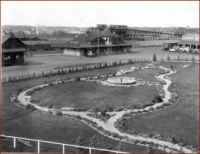 In
1908, Red Deer became the divisional point, effectively assuring the
town that it would become the distribution centre of Central Alberta and a new grand station was
built in 1910 at the head of Ross Street. In
1908, Red Deer became the divisional point, effectively assuring the
town that it would become the distribution centre of Central Alberta and a new grand station was
built in 1910 at the head of Ross Street.
In 1911, the Red Deer based
Alberta Central Railway started construction west of Red
Deer toward Rocky Mountain House and was originally intended to be extended to the Brazeau
coal fields and part of a major interprovincial railway.
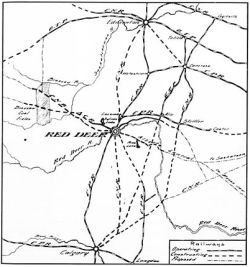 In the same year, the Alberta Midland Railway, a subsidiary of
Canadian Northern Railway, opened a north-south
line between Calgary and Edmonton through Drumheller, Big Valley,
Stettler and Camrose. The
Canadian Northern Western Railway started
construction of a line originating from near Stettler extending west to
just north of Red Deer. It then extended further west to Sylvan Lake on
its way to the Brazeau coal fields. The railway had also planned to build a
north-south Calgary-Edmonton line through Red Deer but construction
never occurred. In the same year, the Alberta Midland Railway, a subsidiary of
Canadian Northern Railway, opened a north-south
line between Calgary and Edmonton through Drumheller, Big Valley,
Stettler and Camrose. The
Canadian Northern Western Railway started
construction of a line originating from near Stettler extending west to
just north of Red Deer. It then extended further west to Sylvan Lake on
its way to the Brazeau coal fields. The railway had also planned to build a
north-south Calgary-Edmonton line through Red Deer but construction
never occurred.
In 1913, a north-south Calgary-Edmonton line was built by the Grand
Trunk Pacific Railway through Three Hills, Delburne, Alix, Mirror and
Camrose using much of the land surveyed by the Alberta and Athabasca
Railway Company.
In the same year, the Lacombe and Blindman Valley Electric Railway
started construction west of Lacombe but did not reach Bentley until
1917 and Rimbey in 1919. The provincial government took over the line
when it went bankrupt, renamed it the Lacombe and Northwestern Railway and sold it to Canadian Pacific in 1928.
 The Canadian Northern Railway
(and its subsidiaries the Canadian Northern Western Railway and the
Alberta Midland Railway) and the Grand Trunk Pacific officially became
part of Canadian National Railways between 1919 and 1923. The Canadian Northern Railway
(and its subsidiaries the Canadian Northern Western Railway and the
Alberta Midland Railway) and the Grand Trunk Pacific officially became
part of Canadian National Railways between 1919 and 1923.
The portion of the Brazeau subdivision of Canadian National between
Rocky Mountain House and Nordegg was abandoned in 1955 when the mines
closed. Around the same time, both railways were well on their way to
converting from steam to diesel and passenger service was declining.
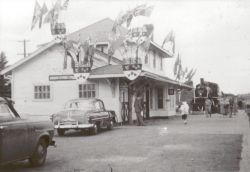 In
1960, the first rail relocation in Western Canada occurred when Canadian
National closed its yard and station at east downtown Red Deer and moved
its operation to the north side of the Red Deer River. In
1960, the first rail relocation in Western Canada occurred when Canadian
National closed its yard and station at east downtown Red Deer and moved
its operation to the north side of the Red Deer River.
Also in 1960, a portion of the Alberta Central subdivision of Canadian
Pacific immediately southwest of Red Deer was relocated from Forth to
Tuttle to accommodate the building of the new Highway 2. In 1983, the
subdivision was abandoned and, in 2009, the portion between Tuttle and
Benalto, including the historic Mintlaw trestle, was sold to Red Deer
County.
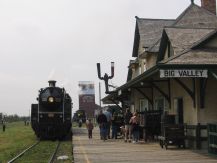
In 1986, the Central Western Railway became western Canada's first
modern day short line railroad when it took over the Stettler
subdivision of Canadian National (formerly Canadian Northern/Alberta
Midland) between a junction south of Camrose and Morrin. In 1992, it
acquired the Coronation subdivision of Canadian Pacific. Much of the
railway was later abandoned except for the portion between Stettler and Big
Valley which is now used for steam train excursions by Alberta Prairie
Steam Tours.
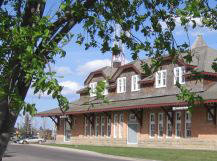 In
1990, the Canadian Pacific line and all its operations was relocated
from downtown Red Deer to the northwest part of the city. Both the
downtown station and river bridge were set for demolition but, due to
some very dedicated citizens, both structures were saved and received
historic resource designation. In
1990, the Canadian Pacific line and all its operations was relocated
from downtown Red Deer to the northwest part of the city. Both the
downtown station and river bridge were set for demolition but, due to
some very dedicated citizens, both structures were saved and received
historic resource designation.

Lines in Central Alberta still in operation today include the CPR
Calgary-Edmonton line through Olds, Innisfail, Red Deer, Lacombe, Ponoka
and Wetaskiwin with about 15 trains per day, the CNR Calgary-Edmonton
line through Three Hills, Delburne, Alix, Mirror and Camrose with about
4 trains per day, the CNR Brazeau subdivision from Mirror to west of
Rocky Mountain House through Joffre, Red Deer north and Sylvan Lake with
about 2-3 trains per day, the CPR Lacombe subdivision east of Lacombe to
the Dow plant with 1 train per day, the CPR northern east-west line
between Edmonton and Saskatoon through Wetaskiwin and Camrose with 2-4
trains per day.
Railway Heritage Preservation
in Central Alberta
The Calgary and Edmonton Railway
(Canadian Pacific)
The Calgary and Edmonton Railway
near Red Deer (Canadian Pacific)
The Alberta Central Railway
(abandoned Canadian Pacific)
The Canadian Northern
Western Railroad (Canadian National Brazeau subdivision)
The Canadian Northern Railway
(Canadian National)
The Forth
Junction Project
|
|
|